


While writing the video learning statistics library, I kept running into the same problem. The most-shared video learning stats and numbers online had almost no traceable source.
"Viewers retain 95% of a message from video."
"Visuals are processed 60,000 times faster than text."
"Humans have the attention span of a goldfish.”
We've all seen them on slides, landing pages and stats roundups. I've seen them all multiple times, myself. But, I couldn’t definitively validate most of them.
So, I picked the most repeated stats about video and visual learning and tried to find where each one came from. Some are real findings stretched way past what they measured, but many have no source at all.
One was even walked back by the company that started it.
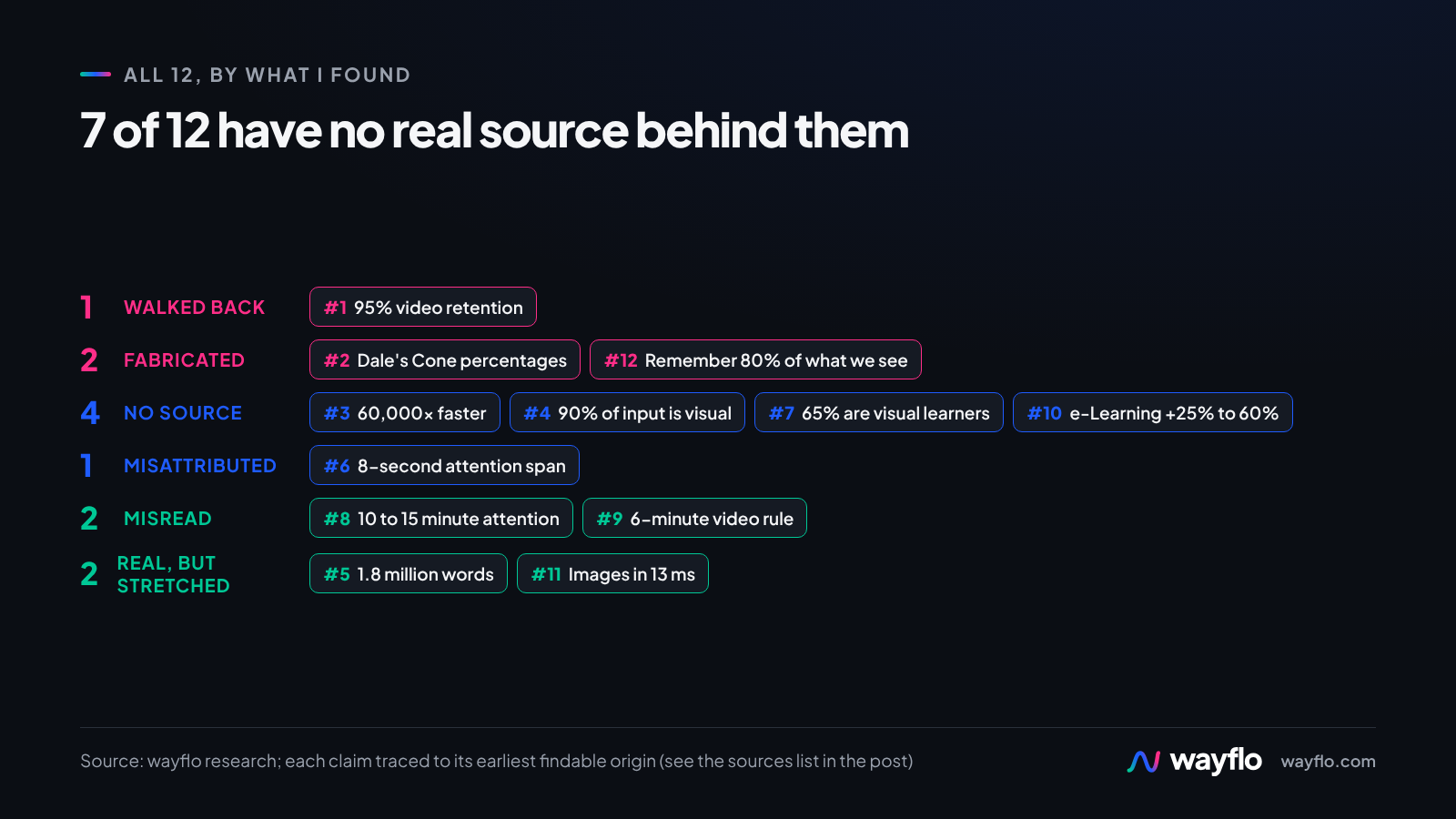
TL;DR: Most misquoted stats about video learning
| Popular video stat | Reality check | |
|---|---|---|
| 1 | Viewers retain 95% of a video message | Walked back by its own source |
| 2 | We remember 10% of what we read... 90% of what we do | Fabricated |
| 3 | Visuals are processed 60,000x faster than text | No source |
| 4 | 90% of information sent to the brain is visual | No source |
| 5 | 1 minute of video is worth 1.8 million words | Real, but just arithmetic |
| 6 | Humans have an 8-second attention span | Misattributed |
| 7 | 65% of people are visual learners | No source, theory unsupported |
| 8 | Students only pay attention for 10 to 15 minutes | Misread |
| 9 | The optimal video length is 6 minutes | Misread |
| 10 | e-Learning increases retention by 25% to 60% | No source |
| 11 | The brain processes images in 13 milliseconds | Real, but stretched |
| 12 | People remember 80% of what they see | Fabricated |
Now, I’ll share each of these statistics with real findings and what’s wrong about them.
"Viewers retain 95% of a message from video vs 10% from text"
This is the most quoted video stat on the internet, usually credited to Insivia or "a Forbes study". I couldn't find any Forbes original.
Insivia's own page now says the number came from a small, self-reported survey of about 200 B2B buyers, run over 16 years ago, and that it was never a study.
If you want a real stat in place of the 95% one, use Noetel et al. (2021): video added to teaching gives a large learning gain, across 105 randomized trials. (Noetel et al., 2021).
It's less catchy, but true.
"We remember 10% of what we read, 20% of what we hear... 90% of what we do"
This comes attached to Edgar Dale's "Cone of Experience".
The problem: Dale's cone never had numbers, and he warned against reading it as a ranking.
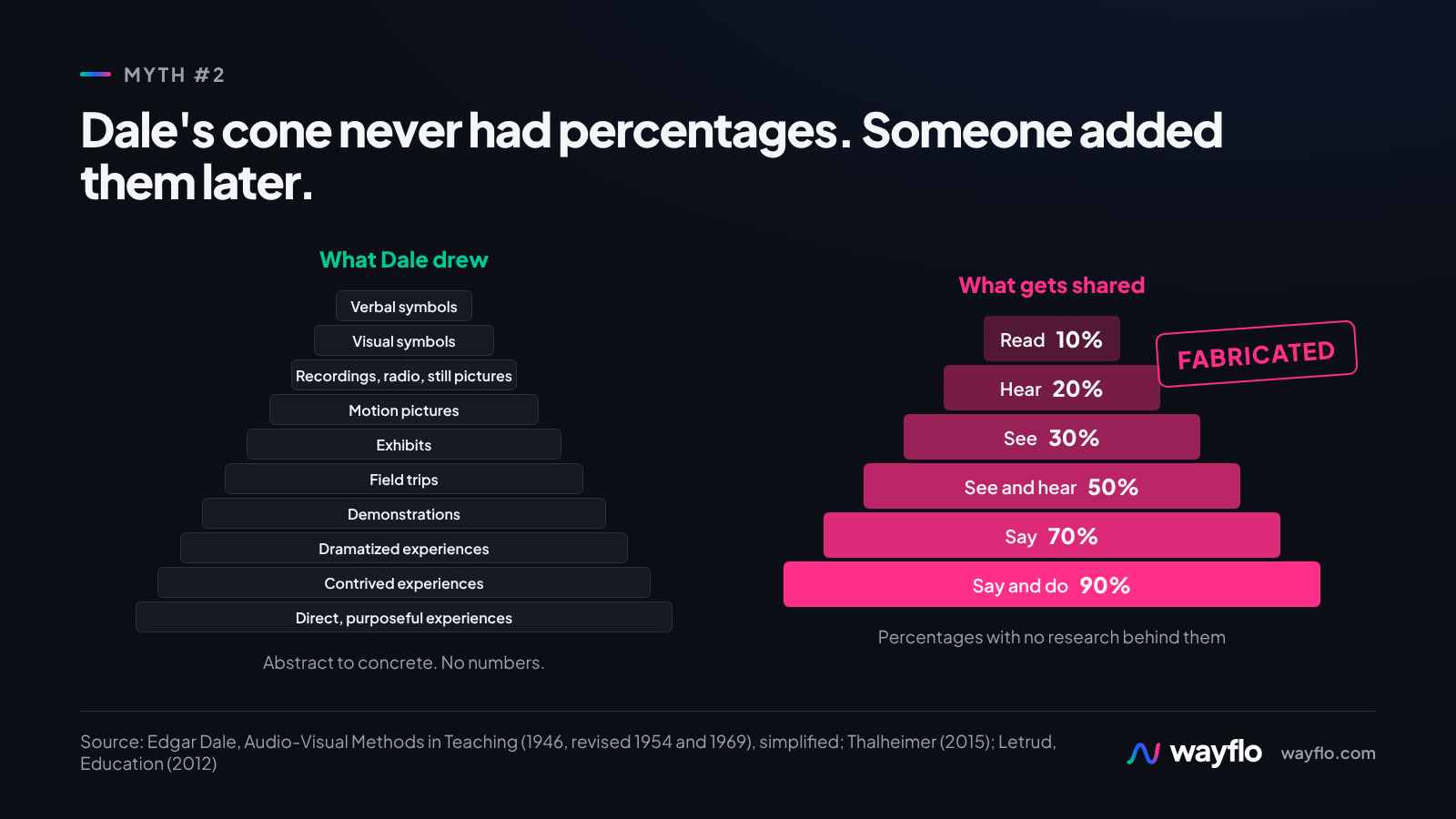
The percentages come from an older retention chart with no research behind it, pasted onto the cone around 1970. The training institute often credited with it says it can't find the original research either. (Thalheimer, Letrud, 2012)
Quote this instead: the real point behind the cone, that doing beats passively taking in, does have evidence.
Taking a practice test beat restudying the same material (g = 0.51) across 272 effect sizes and 15,427 people. (Adesope, Trevisan & Sundararajan, 2017)
"Visuals are processed 60,000 times faster than text"
Learning companies, creators, and startups have quoted this stat for years. But I noticed that the trail ends at a 3M presentation brochure that cites nothing, and before that a 1982 magazine ad.
I also found out about a public bounty for anyone who could find the real study went unclaimed. (PolicyViz, CogDog)
Quote this instead: visuals do help, just by a far more modest margin.
A meta-analysis of 61 studies and 7,036 people found animations beat static graphics by g = 0.23, with narrated animations doing best. (Berney & Bétrancourt, 2016)
"90% of information sent to the brain is visual"
The only traceable research for this statistic is a popular education book whose footnote led me to nowhere.
Researchers who looked at the similar claim that "driving is 90% visual" concluded there's no way to measure such a percentage in the first place. (ImageThink, Sivak, 1996)
"One minute of video is worth 1.8 million words"
This one is real, from a 2008 Forrester analyst. But it's arithmetic, not factual research with reported findings: 1,000 words per picture, times 30 frames a second, times 60 seconds.
Treat is more as a figure of speech than a definitive fact. It tells you nothing about learning outcomes. (IdeaRocket)
"Humans have an 8-second attention span, shorter than a goldfish"
This went viral from a 2015 Microsoft Canada report. I opened the report: the figure sits on page 6, credited to a stats website, and Microsoft's own research didn't measure it.
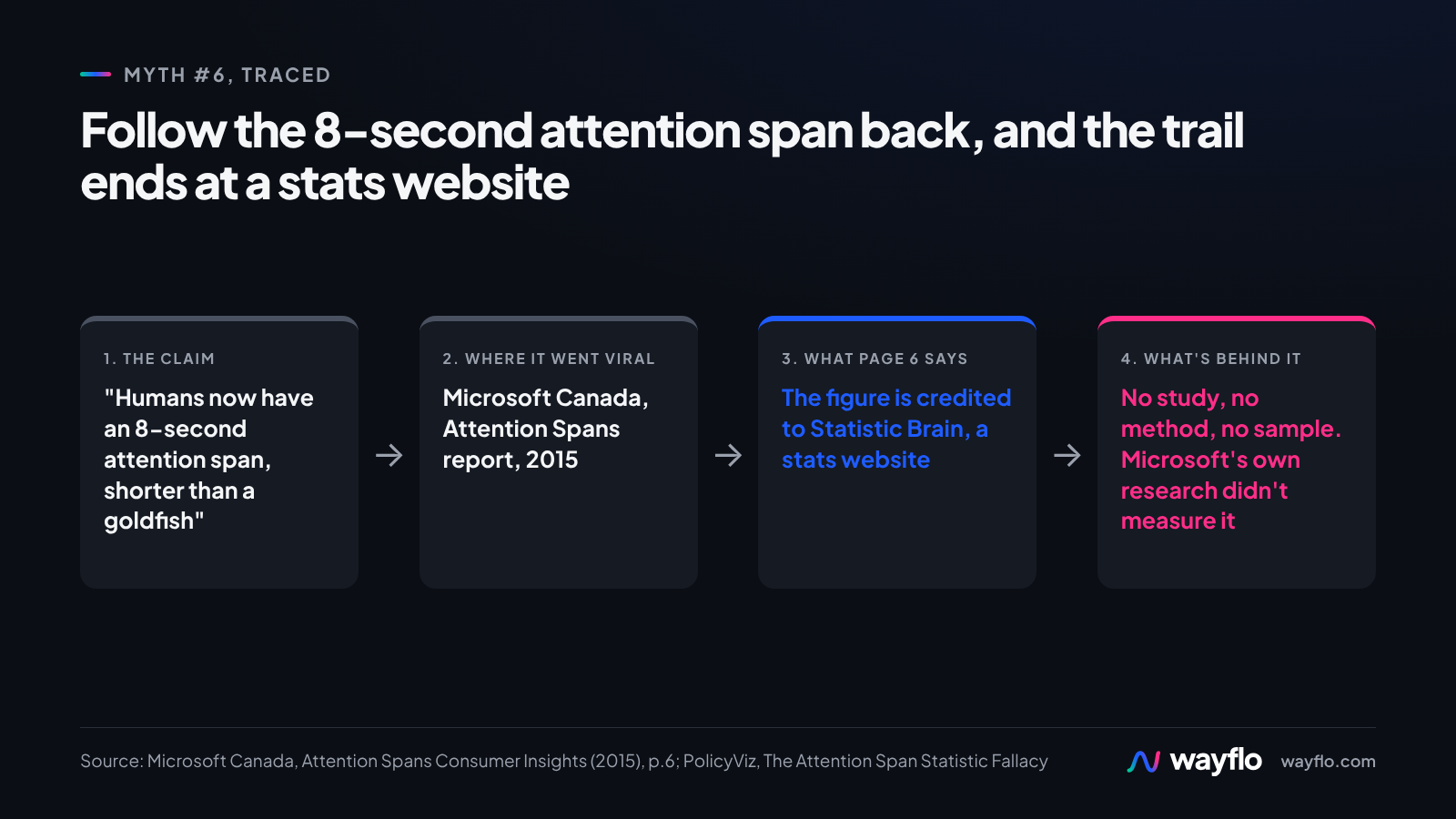
Attention depends on the task, so there's no single attention-span number to measure anyway. (Microsoft report, p.6, PolicyViz)
Quote this instead: if your point is that short-form video is changing how people pay attention, there's now real data.
A 2025 meta-analysis of 71 studies and 98,299 people linked heavier TikTok, Reels and Shorts use with weaker attention (r = -0.38). It's a correlation, not proof of cause, but it's a real number. (Nguyen et al., 2025)
"65% of people are visual learners"
The 65% has no origin I could find. But the bigger problem is the idea underneath it.
A major 2008 review found no good evidence that matching teaching to someone's "learning style" improves how much they learn. People have preferences but teaching as per their preferences doesn't show better results. (Pashler et al., 2008)
"Students only pay attention for the first 10 to 15 minutes"
This gets used to justify short videos, but it started with in-person lectures.
When a researcher traced it back, the original source was a review of note-taking, not attention, and recall stayed fairly stable across lecture lengths. (Bradbury, 2016)
Pro Tip: attention does drift during long videos, but you can do something about it.
Students who got short quizzes between segments of a 21-minute lecture reported mind wandering on 19% of checks, vs 41% for those who didn't. (Szpunar, Khan & Schacter, 2013).
More on that in our interactive video post.
"The optimal video length is 6 minutes"
This is a real finding. But is widely misread out of context.
It comes from 2012 edX data showing how long people kept a video open in free MOOCs.
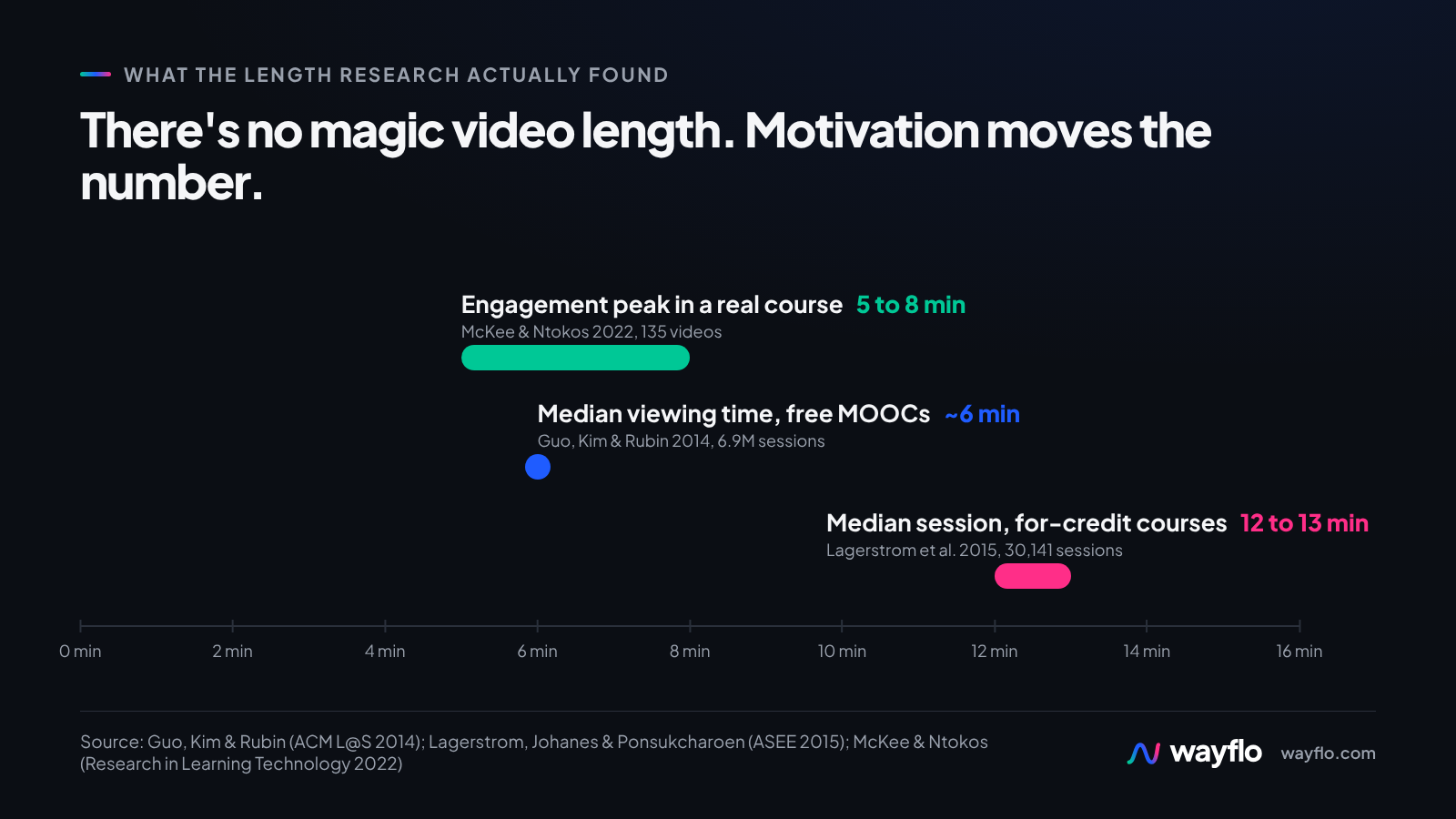
The authors themselves note that viewing time isn't attention, and attention isn't learning.
In fact, in the same study for courses that offer credits, people watched about twice as long. (Guo, Kim & Rubin, 2014)
Quote this instead: a 2022 study of 135 videos in a real university course saw engagement peak at 5 to 8 minutes, with first-year students doing best at 6 to 12. (McKee & Ntokos, 2022).
"e-Learning increases retention by 25% to 60%"
Every page that quotes this credits "the Research Institute of America".
None of them gives a report title, year, method or sample, and I couldn't find one either. (Training Industry, as an example of the citation with no source)
Quote this instead: Replacing traditional teaching with video gave a small learning gain (g = 0.28) across 105 randomized trials; adding video on top gave a large one (g = 0.80). (Noetel et al., 2021)
"The brain processes images in 13 milliseconds"
The MIT study behind this is real.
People could spot a named target in a rapid stream of images shown for 13 milliseconds each.
It was more like a test of recognising the gist, not about understanding or learning, so it says nothing about video vs text. (MIT News)
"People remember 80% of what they see"
This is a remix of the Dale's Cone numbers from the second statistic, I shared above.
Memory for pictures is genuinely strong, but no study gives a fixed 80% figure. I read about this at Learnlets, too.
FAQ
Is the "95% retention from video" stat real?
No. It came from a small, self-reported survey of about 200 B2B buyers, run over 16 years ago. Insivia, the company most often credited with it, now says on its own page that it was never a study.
Did Edgar Dale create the "learning pyramid" percentages?
No. Dale's Cone of Experience had no numbers. The 10%, 20%, 30% figures came from an older retention chart with no research behind it and were attached to the cone around 1970.
Is the human attention span really 8 seconds?
It’s debatable. The 8-second figure came from a 2015 Microsoft Canada report, credited to a stats website, and Microsoft didn't measure it. Attention depends on the task, so there's no single attention-span number.
What's a reliable stat about video and learning?
A review of 105 randomized trials found video added to teaching gives a large learning gain (g = 0.80), while video replacing teaching gives a small one (g = 0.28). It's one of the strongest numbers available.
How can I check if a statistic is real?
Follow the citation back until you reach a study, report or dataset with a named author, a year, a method and a sample size. If the trail ends at a blog, a brochure or "studies show", treat the number as unsourced.
How did I check each stat?
For every stat, I tried to find the first place it appeared: the original study, report or document. Not the blog that quoted the blog that quoted it. Where a researcher or journalist had already done the digging, I read their work and followed their sources too.
A few of these might even be roughly true. Nobody has measured them (or not documented them online). Where a real, checked stat makes the same point, I've added it so you have something to quote instead.
My take on misquoted statistics about video learning
None of these stats are evil. Most started as a rough guess, a sales line or a real finding with a narrow scope, and then got copied until nobody remembered where they came from.
The cost is real, though.
Course creators design around a "6-minute rule" that was never a rule.
Teams buy video tools based on a 95% that was never measured.
Every citation to a misquoted fact makes the next one look more credible. So here's a request: before you quote a stat, click through to the source.
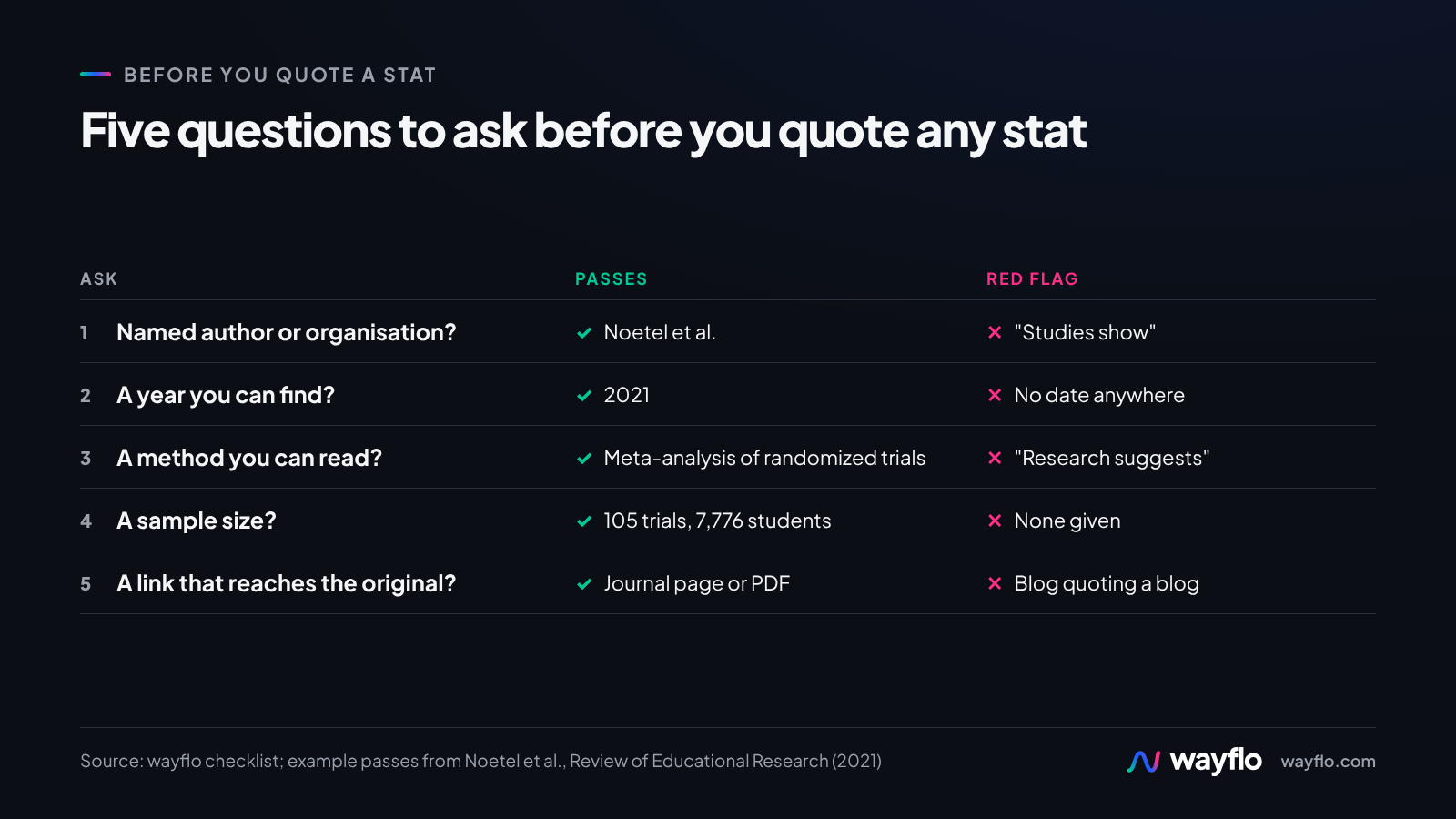
If you can't find one, don't use it, and if you want numbers that do hold up, our video learning statistics library has 90+ of them, each well-traced.